Union Intelligent CNC Industrial Park A&B, Hefei, China 231131
News
Metal Laser Cutting in 2026: Flexibility, Verification, and Smart
Demand is shifting from capacity to flexibility
The clearest change in recent months is the shift in what buyers ask for. Small-batch and customized orders now account for a growing share of work, and equipment specifications are following. Users want machines that switch quickly between stainless, aluminium, galvanized and carbon steel, covering roughly 0.5 to 25mm in a single setup. Modular torch systems, adaptive power control and quick-change fixtures are becoming the expected answer rather than an optional upgrade.
Thick plate still grows, but still unproven
Higher power installations continue to rise, with 15kw and above expected to take a meaningful share of new mid-to-thick plate equipment. At the same time, fiber laser replacement of conventional flame cutting sits at only a moderate level, and machines at 12kw and above are still in a validation phase beyond 60mm. Section quality and stability are the open questions, which makes process data more persuasive than headline wattage.
Automation is finally getting a common yardstick
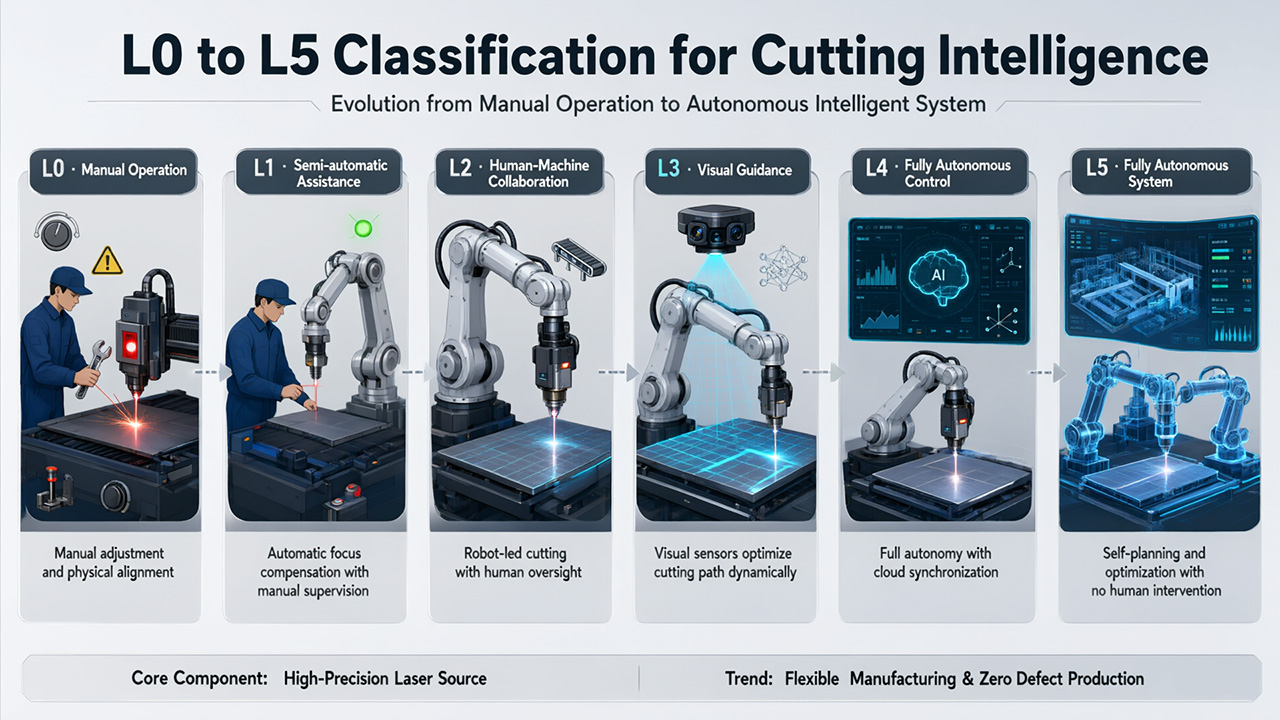
A useful development is the move toward graded definitions. A 2026 enterprise-level white paper introduced a six-level L0 to L5 classification for cutting intelligence, based on who holds the decision-making role during processing, with human operators dominant up to L2 and intelligent systems taking the lead from L3 onward. It is explicitly advisory rather than a criterion, but it gives buyers a reference point in a market where "smart" has meant different things to different vendors.
Energy and reliability are becoming measurable
Unit energy consumption per square metre and auxiliary gas usage are increasingly written into tender requirements. Mainstream vendors have pushed optical conversion efficiency upward, nitrogen cutting substitution is rising, and closed-loop cooling plus waste heat recovery are appearing more often, particularly in automotive parts and power equipment where ESG disclosure is stricter. On reliability, the more credible claims are the quantified ones, such as predictive fault warning windows and monthly unplanned downtime targets, because buyers can convert those directly into lost capacity.
Precision matters, but not in every case
Precision claims are now often paired with material switching capability, including ultra-thin workpieces and fragile materials, supported by dynamic spot adjustment and vision-based thickness recognition. These figures come from supplier statements and should not be treated as industry benchmarks. On alternatives, the honest framing is process boundaries rather than superiority. Ultrafast laser opens a different lane with near-zero heat affected zones for hard and brittle materials, while water-jet guided laser has shown promising results on composite plate but is still described as a 2~3 year path from lab to production. For thick section and cost-sensitive work, plasma and flame retain their place.
Outlook
Automation spending and electric vehicle manufacturing are expected to keep equipment demand above average, while labour shortages shorten replacement cycles for older plasma and mechanical systems. The practical takeaway for 2026 is that competitive advantage is moving away from raw speed toward accuracy, process consistency and serviceability. As a CNC equipment manufacturer with 34 years in the industry, we aim to provide a specific group of users with 3 - 12kW fiber laser cutting machines that are reliable in quality, well supported after sale, and strong in overall performance.




Leave a Comment